
In today’s workplace, leadership is being tested on multiple fronts at once. Leaders are navigating economic uncertainty, rapid technological change, rising employee expectations, and persistent concerns about burnout and retention. Against this backdrop, leadership coaching has shifted from a “nice-to-have” benefit to a strategic lever for organizational success.
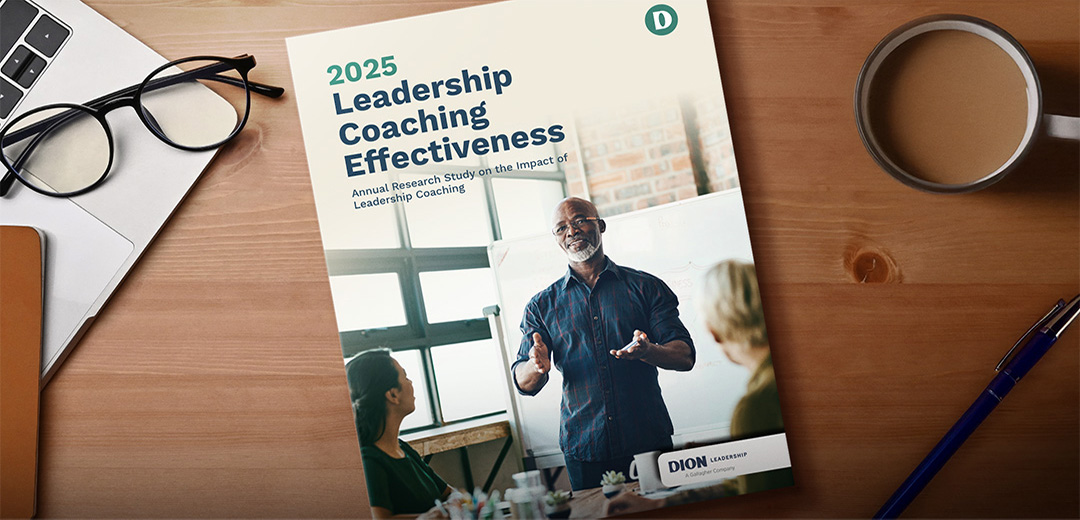
Dion Leadership’s 2025 Leadership Coaching Effectiveness Study—now in its sixth consecutive year—offers compelling evidence that coaching delivers meaningful, measurable impact for both leaders and the organizations they serve. Based on responses from 109 leaders across industries and organizational levels, the findings paint a clear and consistent picture: leadership coaching works.
Coaching Drives Stronger Performance and Behavior Change
At its core, leadership coaching helps leaders think differently, act more intentionally, and build habits that support sustained effectiveness. Our study confirms that nearly all participants experienced tangible performance benefits from their coaching engagements.
In 2025, 96% of leaders agreed that coaching provided insights that helped them perform better in their role, and 93% reported being better equipped to use new behaviors at work. These results closely mirror outcomes from prior years, reinforcing a powerful trend: when leaders invest in coaching, they gain clarity, perspective, and tools they can immediately apply on the job.
Coaching is no longer perceived as remedial. Leaders at the manager, director, vice president, and C-suite levels increasingly view coaching as an essential development strategy—one that supports personal and professional growth amid business complexity rather than just correcting deficiencies.
Confidence and Well-Being: A Critical Leadership Advantage
Confidence remains a cornerstone of effective leadership, particularly in uncertain times. The 2025 study shows that 92% of coachees experienced increased confidence, up five percentage points from the previous year. Confident leaders are better positioned to lead through adversity, make sound decisions, and model resilience for their teams.
Well-being also emerged as a critical outcome. While organizations continue to invest in well-being programs, many still struggle to equip leaders with the skills needed to manage stress, prevent burnout, and create healthy team environments. Coaching plays a meaningful role here: 66% of leaders reported improved well-being as a direct result of coaching, citing gains in focus, stress management, and overall balance.
These outcomes matter—not just for individual leaders, but for the sustainability of organizations facing ongoing talent and engagement challenges.
Retention and ROI: Coaching Makes a Business Case
Perhaps one of the most compelling findings from the study is the impact of coaching on retention. In a year when retention remained the top people strategy for many organizations, 75% of coachees reported that coaching positively influenced their desire to stay with their organization.
This result underscores a substantial return on investment. Losing a leader at the manager level or above carries significant financial and cultural costs. Coaching—even in shorter engagements of four sessions or fewer—can meaningfully influence leaders’ commitment to their organization, strengthening stability and continuity across teams.
When combined with improved well-being, coaching’s positive impact on retention alone can justify an organization’s entire leadership development budget!
Building the Talent Pipeline—Even in a Cooling Labor Market
The study also explored coaching’s role in strengthening the leadership pipeline. While promotions declined slightly in 2025, reflecting broader labor market conditions, 35% of coachees reported taking on increased responsibilities, a notable rise from prior years. This signals growing trust in leaders’ capabilities and readiness to contribute at higher levels.
In environments where advancement opportunities may be limited, coaching helps leaders expand their influence, effectiveness, and scope, positioning them for future growth while delivering immediate organizational value.
What Leaders Are Working On Is Changing
An intriguing shift emerged in leaders’ coaching priorities. Communication, managing others, and executive presence remained top focus areas. However, interest in emotional intelligence declined, while time management and execution increased significantly. This suggests leaders are feeling heightened pressure to deliver results efficiently, even as workloads grow and expectations intensify.
This trend raises an important question for organizations: How do leaders balance operational demands with the relational skills required to build trust, collaboration, and engagement? Coaching provides a space to navigate that tension intentionally.
The Bottom Line
Six years of data tell a consistent story. Leadership coaching delivers real impact—boosting confidence, improving performance, supporting well-being, strengthening retention, and building organizational resilience.
In an era defined by constant change, coaching is more than a development tool. It is a strategic investment in leaders who can think clearly, act decisively, and lead others through complexity. Organizations that recognize this are not just developing better leaders—they are building stronger, more adaptable futures.
To learn more about our coaching programs and the 2025 Coaching Effectiveness Study, please check out our coaching page.
Read Next

Happiness at Work
I am not a big New Year’s resolution person. I believe in the notion of using each day...

Tomorrow’s Workplace Starts Here
Our 2026 catalog is out and ready for you to download! The theme that our team chose...